OSHA porta potty requirements for construction in Pennsylvania
OSHA requires at least 1 toilet for a construction crew of 20 or fewer, and 1 toilet seat plus 1 urinal per 40 workers above that. The rule is federal and applies to private jobsites across Pennsylvania. Below is the full count, the handwashing rule, the mobile crew exception, and the number we actually recommend.
This guide explains the rule in plain English. It is not legal advice. For a ruling on your site, ask OSHA or your safety advisor.
What does OSHA require for toilets on a construction site?
OSHA requires toilets on every construction site under 29 CFR 1926.51(c). A crew of 20 or fewer needs at least 1 toilet. A crew of 20 or more needs 1 toilet seat and 1 urinal per 40 workers. A crew of 200 or more needs 1 toilet seat and 1 urinal per 50 workers.
Pennsylvania does not run its own OSHA plan for private employers. Contractors here follow the federal construction standard, the same one used in Ohio and New York.
The rule is short. Read the full text at OSHA 1926.51. The key parts are Table D-1, the line about temporary field conditions, and the washing facilities section.
| Number of workers | Minimum toilet facilities |
|---|---|
| 20 or fewer | 1 |
| 20 or more | 1 toilet seat and 1 urinal per 40 workers |
| 200 or more | 1 toilet seat and 1 urinal per 50 workers |
Table D-1 from 29 CFR 1926.51(c)(1). Sites without a sewer connection may use chemical toilets, which is what a porta potty is, under 1926.51(c)(3).
How do you count workers for the OSHA porta potty rule?
Count every worker on the site at the same time, including subcontractors, not just your own crew. OSHA's porta potty count is per jobsite. A general contractor with 6 workers and three subs with 6 workers each has 24 people on site. That crew needs 1 seat and 1 urinal under Table D-1.
Use the busiest day, not the average. A framing week with 30 people on site sets the count, even if the site drops to 8 during finish work.
A standard porta potty has a toilet seat and a urinal in one unit. Only one person can use it at a time, so count the line as well as the rule.
When a sub brings their own unit, it counts toward the site total. Agree in writing who supplies the units and who calls for service.
What does "available" mean in the OSHA toilet rule?
"Available" in the OSHA toilet rule means workers can reach a working toilet when they need one. Section 1926.51(c)(2) says that under temporary field conditions, at least one toilet must be available. A locked unit, a full unit or a unit across a busy road does not do that job in practice.
OSHA has explained in its interpretations that employers should not put unreasonable limits on toilet use. A unit that is overflowing because service lapsed is not really available.
Place the unit near where people work, on a cleared path. On a large site, two smaller groups of units beat one group at the far gate.
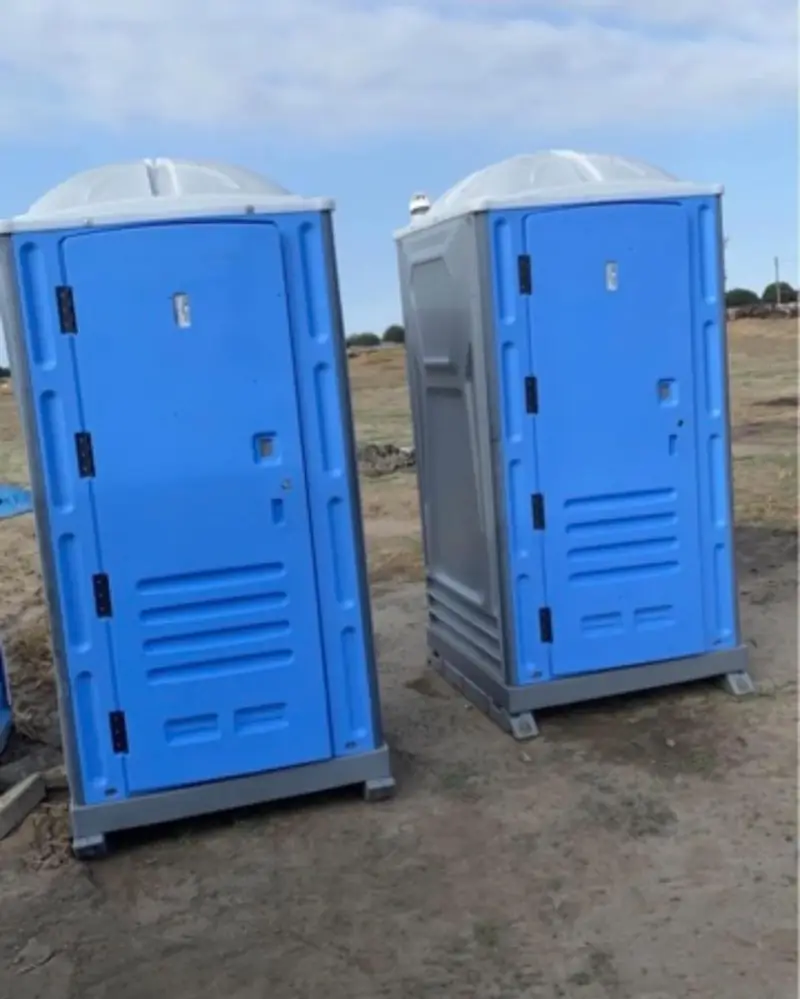
Does a mobile crew need a porta potty?
A mobile crew may not need a porta potty if it has a vehicle ready to drive to nearby toilets. Section 1926.51(c)(4) exempts mobile crews with transportation readily available to nearby toilet facilities. Road crews, line crews and service techs who move every few hours often fall under this exception.
The exception is narrow. A roofing crew that spends three days on one house is not a mobile crew. Neither is a paving crew that stays on one lot all week.
Nearby means close in time, not just on the map. If the nearest gas station is ten minutes away and the crew has one truck, the exception is a stretch.
When the job sits in one place for more than a day, put a unit there. A 7-day short-job rental starts at $145 with one cleaning, before 6% PA sales tax.
Does OSHA require a handwashing station on a jobsite?
OSHA requires washing facilities on a jobsite where workers apply paint, coatings, herbicides or other harmful substances, under 1926.51(f)(1). Section 1926.51(f)(3) also says lavatories must be made available, with soap and towels. Mobile crews with transportation to nearby washing facilities are exempt from that lavatory line.
In practice, most fixed jobsites should have a sink. Crews eat lunch on site, handle concrete, adhesives and treated lumber, and then touch their faces.
Our handwashing station has 2 foot-pump sinks, soap and paper towels, with no hookups. It runs from $145 per 28 days with the toilets' weekly service, before tax.
The lavatory rule calls for running water. Hand sanitizer inside a standard unit helps, but it does not replace soap and water for paint or chemical work.
How many porta potties do we recommend for a jobsite?
We recommend 1 porta potty per 10 workers on a 40-hour week with weekly service. That is more than the OSHA minimum on purpose. Twenty workers sharing one unit fill the tank long before the next cleaning. Above 10 workers per unit, add units or move to twice-weekly service.
| Crew size | OSHA minimum | Our recommendation |
|---|---|---|
| 8 workers | 1 toilet | 1 unit, weekly service |
| 18 workers | 1 toilet | 2 units, weekly service |
| 35 workers | 1 seat and 1 urinal | 4 units, weekly service |
| 60 workers | 2 seats and 2 urinals | 6 units, or fewer with twice-weekly service |
Our numbers are a recommendation, not the law. For guest events and farm crews, see how many porta potties you need.
A clean unit gets used. A full one sends people off site or behind the dumpster. That costs more in lost time than a second unit costs in rent.
Monthly units start at $185 per 28 days with weekly cleaning. Three or more units on one order take 10% off. See construction site toilets for contractor billing.
Crew showing up tomorrow?
Order by 11 a.m. for same-day delivery in the Erie core zone. We text before arrival.
OSHA jobsite toilet questions
These OSHA jobsite toilet questions cover separate facilities, distance, who pays, winter and inspections. The short answer comes first in each one. Remember that this is a plain-English summary of the federal rule, not legal advice, and an OSHA inspector has the final word on your site.
Does OSHA say how far the porta potty can be from workers?
The construction rule does not set a distance. It says toilets must be provided and available. Put the unit close enough that a worker can get there and back without a long trip, on a path that stays clear.
Do we need separate units for men and women?
Table D-1 does not require separate units for men and women. A porta potty is a single locking room, so one person uses it at a time. Many sites add a second unit so workers have a choice, which also helps with lines.
Who has to supply the porta potty, the GC or the sub?
Each employer is responsible for its own workers, so agree on it in the contract. Most Erie jobsites have the general contractor rent the units and the subs share them.
Does the rule apply in winter?
The rule has no winter exception. Units get a non-freezing brine charge from November through March. Read our winter porta potty tips for placement in lake-effect snow.
Do homeowners doing their own work need to follow OSHA?
OSHA applies to employers and their employees. A homeowner working alone is not an employer. Once you hire a crew, their employer is responsible for providing toilets.
Get your itemized quote
Fastest way: call Shawn. You get the price, the delivery day and the total on one call.
(814) 245-2757Mon–Sat, 7 a.m.–7 p.m. Calls are answered in Erie, not a call center.
On a jobsite? Text the address and a photo of the spot to (814) 245-2757.
Prefer a form? Send it here. We reply within 1 business hour during open hours.